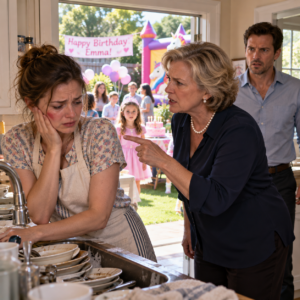
“😢 EVERYONE WAS OUTSIDE LAUGHING AND CELEBRATING MY DAUGHTER’S BIRTHDAY—BUT I WASN’T ALLOWED TO JOIN THEM. 🎂⚠️
My mother-in-law told me I had to stay in the kitchen and wash every plate the guests had used.
When I started crying, she slapped me twice and said, “You still haven’t learned how to behave in this family.” 💔
My name is Laura Bennett. I’m thirty-five, and that Saturday was my daughter Emma’s eighth birthday.
We had spent weeks preparing for it.
Pink balloons.
A unicorn cake.
A rented bounce house in the backyard.
Nearly thirty relatives and school friends came to our home outside Raleigh, North Carolina.
Emma had been excited all morning.
“Mom, you’re sitting next to me when I blow out the candles, right?”
“Of course.”
At least, that was what I believed.
My husband, Daniel, was outside helping the kids with games.
His mother, Margaret, had arrived early and immediately started giving orders.
Move the drinks.
Refill the trays.
Bring more napkins.
Clean the counters.
I did everything because I didn’t want an argument on Emma’s birthday.
Then lunch ended.
Guests carried their dirty dishes into the kitchen.
Within minutes, the sink was full.
So were both counters.
I wiped my hands and started toward the backyard.
Margaret blocked the doorway.
“Where are you going?”
“Emma’s about to open her presents.”
She pointed toward the sink.
“Not until those are done.”
I thought she was joking.
“Margaret, it’s my daughter’s birthday.”
“And these are your guests too.”
“I’ll wash them later.”
“No.”
Outside, I heard everyone singing and laughing.
Emma called for me.
“Mom!”
I stepped toward the door.
Margaret moved in front of me again.
“You’re staying here.”
Something inside me finally broke.
“I planned this whole party. I haven’t even taken one picture with my daughter.”
My eyes filled with tears.
Margaret rolled her eyes.
“Oh, stop.”
I turned back toward the sink because I didn’t want her to see me cry.
That was when she grabbed my arm.
“Look at me when I’m talking to you.”
I turned.
She slapped me once.
I froze.
Then she slapped me again.
“You still haven’t learned how to behave in this family.”
For several seconds, I couldn’t speak.
Outside, the birthday music kept playing.
Children were laughing.
Nobody knew what was happening ten feet away.
Margaret straightened her blouse.
“Now wash the dishes and fix your face before you embarrass Daniel.”
I looked at the kitchen window.
From there, I could see Emma standing beside her cake.
She was looking toward the house.
Waiting for me.
Then I noticed someone else.
Daniel.
He was standing just outside the back door.
Completely still.
His face had changed.
Margaret hadn’t seen him yet.
I wiped my tears.
She turned toward the sink and said:
“And don’t even think about telling my son. He knows his place in this family.”
Behind her, the door slowly opened.
Daniel stepped into the kitchen.
And from the way he was looking at his mother, I knew he had heard every word.
What happened next…? Part 2:…..”
Daniel closed the back door behind him.
Margaret turned.
For the first time all day, she had nothing to say.
Daniel looked at my face.
Then at the red marks on my cheek.
“Did you hit her?”
Margaret recovered quickly.
“Daniel, don’t start.”
He didn’t raise his voice.
“Did you hit Laura?”
“She was hysterical.”
“That wasn’t my question.”
Margaret folded her arms.
“She was being disrespectful.”
Daniel’s jaw tightened.
Behind the door, we could still hear children laughing.
Emma shouted something about presents.
I wanted to go outside.
I also wanted to disappear.
Daniel stepped between me and his mother.
“Leave.”
Margaret stared at him.
“This is my granddaughter’s party.”
“Not anymore.”
“You’re going to throw your own mother out because your wife is crying?”
“No.”
He looked at her.
“I’m throwing you out because you put your hands on her.”
Margaret laughed once.
A short, disbelieving sound.
“You have no idea what she’s been like lately.”
I looked at Daniel.
That sentence bothered me.
“What is that supposed to mean?”
Margaret’s eyes moved between us.
“Ask your husband.”
Daniel went still.
My stomach tightened.
“Ask him what?”
Margaret seemed almost pleased now.
“How many times he’s called me because he couldn’t deal with you.”
Daniel turned toward her.
“Stop.”
But it was too late.
She continued.
“The crying. The complaining. The way you question every little thing.”
I looked at him.
“You called her about me?”
Daniel’s face changed.
“Laura, not now.”
That answer hurt more than I expected.
Margaret picked up her purse.
“There. Maybe now she’ll understand I didn’t come here for fun. I’ve been keeping this family together because you asked me to.”
Daniel shook his head.
“I never asked you to hit my wife.”
“No. You just told me she needed to learn boundaries.”
The kitchen went silent.
I felt something inside me go cold.
“What boundaries?”
Daniel looked toward the floor.
Margaret answered for him.
“Respect. Gratitude. Not fighting him over every decision.”
I stared at my husband.
“What decisions?”
“Laura—”
“No. What decisions?”
He exhaled slowly.
Then Margaret said, “The house. Emma’s school. The savings account.”
My heart started beating harder.
“What savings account?”
Daniel’s head snapped toward her.
Margaret realized she had gone too far.
That was the moment I knew there was more.
Daniel opened the back door.
“Mom. Leave.”
She didn’t move.
He stepped closer.
“Now.”
This time she went.
She walked through the backyard while thirty guests pretended not to notice.
Daniel waited until the side gate closed.
Then he turned toward me.
“I’m sorry.”
I shook my head.
“Not yet.”
“Laura—”
“What savings account?”
He rubbed his hands over his face.
“Emma has an education account.”
“I know.”
“I moved some money.”
My stomach dropped.
“How much?”
“It was temporary.”
“How much?”
“Twenty-two thousand.”
I gripped the counter.
“From our daughter’s college fund?”
“I was going to put it back.”
“For what?”
He didn’t answer.
I looked toward the backyard.
Emma was opening a box with a pink bow.
Everyone clapped.
Then Daniel said quietly, “My mother needed it.”
I stared at him.
“For what?”
“She was behind on the mortgage.”
Margaret had spent the last year telling me we were irresponsible with money.
She criticized groceries.
Vacations.
Emma’s dance lessons.
All while Daniel had taken twenty-two thousand dollars from our daughter’s account to help her.
“When?”
“Four months ago.”
“And you didn’t tell me.”
“I knew you’d say no.”
“Yes.”
“I know.”
“No, Daniel. You knew I had a right to say no.”
He looked away.
That distinction mattered.
Then I remembered Margaret’s words.
He knows his place in this family.
I had always thought she meant Daniel would defend her.
Now I understood something uglier.
She expected access.
To him.
To our money.
To our decisions.
And Daniel had been giving it to her quietly.
I walked toward the backyard.
“Where are you going?”
“To my daughter.”
“Can we talk first?”
“No.”
I stepped outside.
Emma saw me immediately.
“Mom!”
She ran across the patio carrying a stuffed unicorn.
I knelt and hugged her.
She touched my cheek.
“Why is your face red?”
For one terrible second, I didn’t know what to say.
Then Daniel came up behind us.
“Grandma left.”
Emma frowned.
“Why?”
Daniel looked at me.
I waited.
He had spent years letting me carry the discomfort whenever his mother crossed a line.
This answer belonged to him.
He crouched beside Emma.
“Because Grandma hurt Mom, and that isn’t allowed.”
Emma looked at him.
“Like hit her?”
Daniel’s face tightened.
“Yes.”
The party noise seemed to disappear around us.
Emma hugged me harder.
Then she whispered something I almost didn’t hear.
“She hits me too.”
I pulled back.
“What?”
Daniel went completely still.
Emma looked toward the side gate Margaret had just walked through.
“Not hard.”
My blood went cold.
“Emma, when?”
She looked embarrassed.
“When you’re not there.”
Daniel whispered, “What do you mean?”
Emma rubbed one arm with the opposite hand.
“She says little slaps don’t count if they don’t leave marks.”
I looked at my husband.
His face had drained of color.
Then Emma added, “She said Dad knows.”
Daniel sat down on the patio chair like his legs had stopped working.
I stared at him.
“Does he?”
Emma looked between us.
“I don’t know.”
Neither did I.
And suddenly the money wasn’t the worst secret Margaret had expected our family to keep.
The party ended early.
Not with an announcement.
Not with a scene.
People simply began leaving once they sensed something had happened.
A few relatives asked whether everything was okay.
Daniel said no.
That surprised me.
Normally, he would have smiled and protected the appearance of things.
“Family issue,” he said. “We need some time.”
Within forty minutes, the backyard was nearly empty.
The bounce house still hummed.
Half the cake remained untouched.
Pink balloons bumped against the fence in the afternoon breeze.
Emma sat at the kitchen table coloring while I washed my face in the downstairs bathroom.
Not the dishes.
I left those exactly where they were.
When I came back, Daniel was sitting across from Emma.
He looked destroyed.
“Sweetheart,” he said carefully, “when did Grandma hit you?”
Emma colored one unicorn wing purple.
“Sometimes when I’m bad.”
“You’re not bad.”
She shrugged.
“When I talk back.”
“What does that mean?”
“She says I make faces.”
I sat beside her.
“Does she slap your face?”
“Sometimes my hand. Sometimes my arm.”
“Has she ever hit your face?”
Emma hesitated.
Then nodded.
Daniel covered his mouth with one hand.
I felt anger rise, but I kept my voice steady.
“Why didn’t you tell us?”
Emma looked at me as if the answer were obvious.
“Grandma said Dad already knew.”
Daniel’s eyes closed.
“She said he told her I need to listen better.”
That part was true.
Not the hitting.
But Daniel had complained to Margaret about Emma too.
Bedtime arguments.
Back talk.
Homework.
Normal eight-year-old behavior.
He had handed his mother our daughter’s mistakes the same way he had handed her mine.
Information.
Authority.
Permission, even if he never intended it to become physical.
Daniel looked at Emma.
“I did tell Grandma sometimes when I was frustrated.”
She nodded.
“But I never told her she could hit you.”
“I know.”
“How?”
Emma shrugged again.
“Because you don’t hit me.”
That nearly broke him.
He stood and walked toward the sink.
I watched his shoulders shake once.
Then he steadied himself.
“We need to call someone.”
I knew what he meant.
A pediatrician.
A counselor.
Maybe more.
Because once a child tells you an adult has been hitting them, you don’t solve it with a family conversation and a promise.
We called Emma’s pediatrician first.
The office connected us with an after-hours nurse, who asked questions calmly.
Were there injuries?
Marks?
Pain?
Had she been hit with objects?
Had she been afraid to go to Margaret’s house?
Emma had no visible injury that afternoon.
She said Margaret used an open hand.
Mostly quick slaps.
Sometimes squeezing her arm hard.
The nurse advised us to document what Emma said without repeatedly questioning her and to contact the appropriate child-protection resources for guidance.
Daniel made the call.
I listened.
He gave his mother’s name.
Our address.
Emma’s age.
Then he said the words out loud.
“My mother has been hitting my daughter.”
Something shifted in him after that.
Maybe saying it to a stranger removed the family excuses.
Not discipline.
Not old-fashioned parenting.
Not Grandma being strict.
Hitting.
We also arranged for a therapist who worked with children and family boundaries.
Emma asked whether she had done something wrong by telling us.
I said no.
Daniel said it too.
Then she asked the question I had been expecting.
“Is Grandma going to jail?”
“We don’t know,” I said.
“Do I have to see her?”
“No.”
That answer came from both of us at exactly the same time.
Emma looked relieved.
That told me enough.
That night, after she went to sleep, Daniel and I sat at the dining-room table.
The dirty birthday plates were still stacked in the kitchen.
Neither of us cared.
I put the bank statements in front of him.
He had printed them after the party.
Twenty-two thousand dollars transferred out of Emma’s education account.
Two separate withdrawals.
Then smaller transfers from our joint savings.
Six thousand.
Four thousand.
Three thousand.
I looked up.
“This is more than twenty-two.”
Daniel nodded.
“How much have you given Margaret?”
He stared at the table.
“About forty-three thousand over two years.”
My chest tightened.
I had spent those two years hearing how careless I was.
Margaret criticized me for buying Emma new shoes before the old ones were completely worn.
She once complained because I ordered takeout twice in one week.
She called me spoiled for paying a cleaner after I had pneumonia.
All while Daniel was secretly sending her money.
“What was it for?”
“Mortgage payments. Credit cards. Some medical bills.”
“Is she broke?”
“No.”
That answer surprised me.
“What?”
“She has retirement income.”
“Then why?”
He rubbed his face.
“Because she spends more than she has.”
Vacations.
Home renovations.
A newer SUV.
Helping Nicole with a business that never worked out.
Then when bills arrived, Margaret called Daniel.
He paid.
“Why didn’t you tell me?”
He looked at me.
“Because you already didn’t like her.”
“That isn’t an answer.”
“I knew you’d want me to stop.”
“Yes.”
He nodded.
“I know.”
Again.
I know.
He had known my answer, so he removed my chance to give it.
That was not conflict avoidance.
It was decision-making without me.
Then I asked something harder.
“What exactly have you been telling her about me?”
Daniel went quiet.
“Everything.”
“What does everything mean?”
“Our arguments.”
“Which ones?”
“Most of them.”
I stared at him.
He had told Margaret when I complained that she visited without calling.
When I wanted Emma in a different school.
When I thought we should reduce holiday spending.
When I asked him to stop paying Nicole’s phone bill.
When I said Margaret spoke to me disrespectfully.
Each time, he went to the person I was having a problem with and told her how I felt.
Margaret then used that information to frame me as difficult.
Controlling.
Ungrateful.
Too sensitive.
And Daniel began hearing the same description enough that it started sounding true.
“Did you tell her I needed to learn boundaries?”
He flinched.
“Yes.”
The kitchen seemed to get quieter.
“What did you mean?”
“That we needed to stop fighting her over every little thing.”
“We?”
“I know.”
“Stop saying that.”
He looked at me.
“I don’t know what else to say.”
“Then say what you did.”
His eyes filled.
“I made her feel like she had authority over you.”
That was closer.
“And Emma?”
He swallowed.
“I gave her reasons to think she had authority over Emma too.”
There it was.
I did not forgive him that night.
I didn’t leave either.
I simply told him I needed space.
For the first time in our marriage, he did not argue.
Margaret called the next morning.
Then again.
Then eleven more times.
I blocked her.
Daniel didn’t.
Not immediately.
On the twelfth call, he answered.
I was in the room.
He put her on speaker.
Her voice came through sharp and offended.
“So this is what Laura wanted?”
Daniel closed his eyes.
“No.”
“She’s finally got you turning against your own mother.”
“This is about Emma.”
“I corrected her.”
“You hit her.”
“Don’t be dramatic.”
He stared at the phone.
I recognized that phrase.
She had used it on me for years.
Then Margaret said, “You told me that child needed discipline.”
Daniel’s face changed.
“I told you she argued about bedtime.”
“Exactly.”
“I did not give you permission to hit her.”
“I’m her grandmother.”
“That doesn’t give you permission either.”
There was a pause.
Then Margaret attacked me.
“Laura has poisoned both of you.”
Daniel did something I had never seen before.
He did not defend me with a speech.
He did not try to persuade Margaret I was good.
He simply said, “Do not speak about my wife that way.”
Margaret laughed.
“So now she’s your wife before I’m your mother?”
I watched his face.
That question had controlled him for years.
Choose.
Wife or mother.
Loyal son or bad son.
Daniel finally answered differently.
“Those aren’t competing positions.”
Silence.
“Laura being my wife doesn’t take anything from you. Emma being my daughter doesn’t either.”
Margaret began crying.
I waited for him to fold.
He didn’t.
Then she said, “After everything I’ve done for you.”
Daniel looked at the bank statements.
“Mom, I’ve been paying your bills for two years.”
She stopped crying.
That silence was revealing.
He continued.
“The money stops today.”
“What?”
“The automatic transfers. Everything.”
“You can’t do that.”
“It’s our money.”
“I need that help.”
“Then we can discuss a real budget later with a financial adviser. But I am not taking another dollar from Emma’s account or hiding money from Laura.”
Margaret’s voice hardened.
“She put you up to this.”
“No.”
He looked at me.
“I did this.”
Then he ended the call.
His hands were shaking.
I did not congratulate him.
One boundary after years of enabling did not erase anything.
But I noticed.
The investigation into Margaret’s treatment of Emma did not become some dramatic criminal case.
There were interviews.
Documentation.
A child advocate spoke with Emma once in a setting designed not to make her repeat everything endlessly.
Margaret admitted to “light spanking” and “corrective taps.”
She insisted she had grown up with worse.
That defense did not help her.
She was ordered to have no unsupervised contact with Emma while the matter was reviewed.
Eventually, we chose to maintain that restriction ourselves regardless of the formal outcome.
No visits without us.
No discipline.
No taking Emma anywhere alone.
At first, Margaret refused those terms.
So she did not see Emma.
For six months.
Then nine.
She sent birthday cards.
Christmas gifts.
Messages through relatives.
I returned anything containing guilt.
One card said:
Grandma misses you even though your mother won’t let us be a family.
I mailed it back unopened after reading the outside note Margaret had attached.
Daniel supported that.
His relatives did not.
His aunt called me cruel.
His cousin said children need grandparents.
Linda—Daniel’s oldest sister—told him he was destroying their mother.
Daniel began learning what happened when he stopped carrying Margaret’s emotions for everyone.
The family pushed them back onto him.
He started therapy.
Not couples therapy first.
His own.
I did too.
I needed somewhere I could say the ugliest part out loud.
I did not know whether I still respected my husband.
That frightened me more than asking whether I loved him.
Love was still there.
That was inconvenient.
I loved the man who packed Emma’s lunch before work.
The man who knew how I liked my coffee.
The father who slept on the floor beside Emma when she had the flu.
I also resented the man who had discussed me with his mother until she believed she was entitled to discipline me.
The man who secretly gave away our money.
The man who heard me complain about Margaret for years and translated my discomfort into evidence that I was difficult.
Both were real.
Therapy did not simplify him.
It made me stop trying to.
Daniel eventually told me where the pattern began.
His father died when he was fourteen.
Margaret turned Daniel into the “man of the house.”
Not officially.
Emotionally.
She told him he was different from other boys because he understood responsibility.
When money was tight, she told him how worried she was.
When Nicole struggled, Daniel helped.
When Margaret was lonely, Daniel stayed home.
When he went to college, she called constantly.
He learned very early that being a good son meant preventing his mother from feeling abandoned.
Then he married me.
Every boundary I requested felt, to him, like asking him to injure her.
So instead of disappointing Margaret, he disappointed me quietly.
That explained him.
It did not excuse him.
He understood that distinction eventually.
“I thought avoiding a fight with her was keeping peace,” he said during one counseling session.
“And what was it?” the therapist asked.
Daniel looked at me.
“Moving the fight into my marriage.”
That was exactly right.
Emma changed too.
At first, she became nervous anytime an adult sounded irritated.
If a teacher corrected her, she apologized repeatedly.
If I sighed while cooking, she asked whether I was mad at her.
Her therapist helped us see how much she had learned to manage adult moods.
That hurt.
We created new rules at home.
Adults handle adult feelings.
Emma could apologize when she actually did something wrong.
She did not need to apologize because someone else was upset.
No secret punishments.
No relative could discipline her without our explicit agreement.
And no adult was allowed to tell her that one parent “already knew” about something she had not discussed with us.
That last one came from Emma.
“I want to check myself,” she said.
So we told her she always could.
A year after the birthday party, Margaret asked for a meeting.
Not with Emma.
With Daniel and me.
We met in a therapist’s office.
I expected excuses.
There were some.
She talked about her generation.
Discipline.
Respect.
How hard it had been to raise children alone.
Then the therapist asked, “Why did you hit Laura?”
Margaret said, “She was disrespectful.”
The therapist repeated the question.
Margaret became irritated.
“I just told you.”
“No. You told me what you think Laura did. Why did you choose to hit her?”
Margaret went silent.
For the first time, she had nowhere to move responsibility.
Eventually she said, “Because I knew Daniel wouldn’t stop me.”
I looked at him.
He looked sick.
But that answer mattered.
She had understood the family structure perfectly.
Daniel might complain later.
He might ask her to apologize.
But he would not truly challenge her.
Until that birthday.
The therapist then asked why she hit Emma.
Margaret’s answer took longer.
“Because she reminds me of Laura.”
I felt cold.
“How?”
“She questions.”
That was all.
Questions.
The thing Margaret called disrespect.
Emma asked why.
Why can’t I have another cookie?
Why do I need to change clothes?
Why does Grandma get to decide?
Ordinary child questions.
Margaret saw my resistance in them.
So she treated Emma like a smaller version of me.
That was when I ended the meeting.
Not angrily.
I simply stood.
“I’m done for today.”
Daniel stood with me.
Margaret looked shocked.
“But we’re not finished.”
“I am.”
That felt important.
For years, Margaret decided when conversations ended.
Now I did.
Rebuilding any relationship with her took another year.
Very slowly.
Supervised lunches.
Public places.
No criticism about parenting.
No private conversations with Emma.
If Margaret broke a rule, the visit ended.
The first time she criticized Emma’s clothes, Daniel stood up and said, “We’re leaving.”
Margaret stared at him.
He did not argue.
We left.
The next visit went better.
Change was not warm.
It was repetitive.
Boundary.
Consequence.
Boundary.
Consequence.
Eventually, Margaret learned that our limits were not invitations to negotiate.
Whether she truly agreed with them mattered less than whether she followed them.
Daniel and I came much closer to separating than most people knew.
For almost four months, he slept in the guest room.
We did not pretend everything was fine for Emma.
We simply told her we were working through adult problems and she was not responsible for fixing them.
That sentence became important in our house.
Not your job.
When she tried to cheer us up after an argument:
Not your job.
When she asked whether Grandma was lonely:
Not your job.
When she wondered if Daddy was sad:
You can care. Still not your job.
Eventually, Daniel and I decided to stay married.
Not because the birthday incident became small.
It never did.
Because his behavior changed consistently over time.
He gave me full access to every account.
We created rules for family loans.
Neither of us could give significant money to relatives without discussing it first.
He stopped sharing our marital arguments with Margaret.
If he needed advice, he used a therapist or a friend who was not personally involved.
Most importantly, when I said his mother crossed a line, he stopped beginning with an explanation for her.
He listened first.
That sounds small.
It changed everything.
Emma is eleven now.
She remembers her eighth birthday, but not primarily because of the cake or bounce house.
She remembers me missing the beginning of the presents.
She remembers Margaret leaving.
And she remembers her father telling her that Grandma had hurt me and that it was not allowed.
A few months ago, Emma asked why I had stayed in the kitchen so long that day.
I could have said I was trying to keep peace.
Instead I told her the truth.
“I thought being a good wife meant not causing a scene.”
She frowned.
“But Grandma caused the scene.”
I smiled.
“Exactly.”
Children sometimes arrive at the truth faster because they haven’t spent decades learning complicated excuses.
The old birthday photographs are still on my phone.
There is one of Emma standing beside the unicorn cake before everything happened.
She is looking toward the kitchen.
Waiting for me.
For a long time, I couldn’t look at that picture without feeling ashamed.
Now I see it differently.
I did come outside.
Later than I should have.
With red cheeks and a marriage that suddenly looked different.
But I came.
And after that day, I stopped confusing endurance with harmony.
I stopped believing keeping a family together meant allowing one person to decide who had to shrink.
Margaret once told me I hadn’t learned how to behave in her family.
She was right about one thing.
I never did.
Instead, Daniel and I had to learn how to build a family where nobody earns belonging by accepting humiliation.
And where my daughter never has to stand ten feet away from me, waiting for an adult to give me permission to be her mother.
—–THE END—–