My 10-Year-Old Daughter Built Her School Project Around the Father She Was Proud Of—Then Her Teacher Gave Her a Zero in Front of the Class and Said She Had Invented My Navy Service Because “Real SEALs Don’t Work Quiet Jobs in Virginia.”
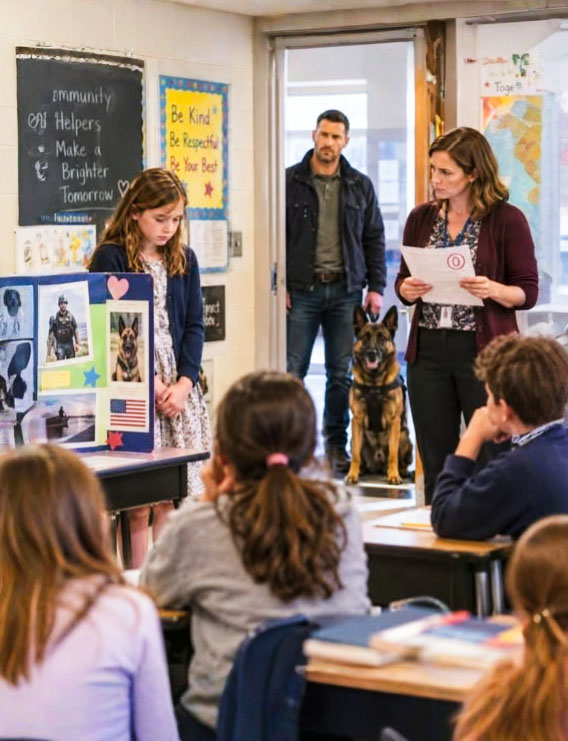
My daughter did not tell me she had gotten a zero.
She came home at 3:42, dropped her backpack by the stairs, filled Atlas’s water bowl, and asked whether we could have grilled cheese for dinner.
Everything sounded normal.
Too normal.
Emily was ten years old and had never been good at pretending disappointment didn’t exist.
When she lost a soccer game, you knew.
When somebody left her out of a birthday party, you knew.
When a book ended badly, the entire house knew.
That afternoon, she barely spoke.
Atlas noticed first.
He was a Belgian Malinois, dark-faced, lean, and beginning to gray around the muzzle.
He had been retired from working life for three years.
With me, he was disciplined.
With Emily, he was ridiculous.
She could put a paper birthday hat on him and he would tolerate it with the long-suffering expression of a man questioning every decision that led him there.
He followed her into the kitchen and pressed his head against her leg.
She rubbed one ear.
“You’re needy.”
Atlas did not move.
Neither did she.
I was making soup when I noticed a corner of blue poster board protruding from her backpack.
“Hey.”
She looked up.
“You want to show me your project?”
“No.”
That answered several questions.
The project had been all she talked about for a week.
Career and Community Week.
Each student had to choose an adult whose work had affected other people, interview that person, and explain why the job mattered.
Emily chose me.
I almost told her to choose somebody else.
Not because I was ashamed of my career.
The opposite.
I had simply spent most of my adult life learning that some things did not improve by being turned into dinner-table stories.
I joined the Navy at nineteen.
Later, I entered Naval Special Warfare.
I stayed fourteen years.
I served with men whose names I still thought about more often than I said aloud.
I worked around military working dogs for part of that career, although Atlas and I were not paired together for all of it.
He came into my life later through a training program, and when he retired, circumstances lined up so that he came home with me.
By then Emily was seven.
She decided within forty-eight hours that Atlas belonged to her.
He disagreed for approximately a week.
Then he started sleeping outside her bedroom.
When I left active duty, I moved back to Virginia and began working as a civilian training consultant for working-dog teams.
The job was steady.
Useful.
Private.
I liked private.
At Emily’s school, I did not introduce myself as a former SEAL.
I introduced myself as her father.
I never included details about Naval Special Warfare on routine school forms because there was no reason to.
When another parent asked what I did, I said canine training.
If they wanted more, I sometimes said I had been in the Navy.
Usually that was enough.
Emily knew more.
She had seen photographs.
She knew some of the men I still called.
She knew Atlas had been trained for work before he became the animal who stole bacon off her plate when he thought nobody was looking.
Before she started the assignment, I gave her three rules.
“No mission stories.”
“I know.”
“No names of people I haven’t said are okay.”
“I know.”
“And if you don’t know something, say you don’t know.”
She sighed dramatically.
“Dad, I’m ten. I know what research is.”
“Dangerous confidence.”
She threw a pencil at me.
The finished project was titled:
THE JOB NOBODY SEES — MY DAD AND ATLAS.
She talked about teamwork.
Discipline.
Training.
Trust between handlers and dogs.
She included one photograph of me in Navy working gear that had already been publicly released years earlier.
Another showed Atlas in an old harness.
Nothing was sensitive.
Nothing was exaggerated.
I had checked it myself.
So when I pulled the poster from her backpack that afternoon and saw the red zero on the grading sheet, I assumed she had forgotten a source page.
Then I read the note.
Unsupported claims. Student was given an opportunity to correct fictional material and refused.
I looked at Emily.
“What happened?”
She stared at the floor.
“Ms. Caldwell said I lied.”
“About?”
“You.”
I sat at the kitchen table.
“Come here.”
She did, slowly.
Atlas followed.
Emily told me the story in pieces.
She had presented after lunch.
Everything went well until one student asked, “Was your dad a Navy SEAL?”
Emily said yes.
According to her, Ms. Caldwell immediately interrupted.
She asked whether that information had been verified.
Emily said I had told her.
The teacher said a parent was not an independent source.
That part, by itself, would not have bothered me.
It was a research project.
Teachers should teach children how to verify information.
What happened next did.
Ms. Caldwell told Emily she had looked up my name after reading the project summary.
She found my civilian work.
A company page described me as a canine training consultant.
A community veterans event listed me only as “former Navy.”
Apparently that was enough for her to decide the rest was invented.
Emily said Ms. Caldwell told the class, “Real military service should never be embellished for attention.”
I felt my jaw tighten.
“Exact words?”
“I think so.”
“Keep going.”
Then the teacher said something close to:
“Real SEALs don’t quietly train dogs in Virginia suburbs.”
A few students laughed.
Emily told her she was wrong.
Ms. Caldwell told her not to argue.
Emily insisted again that I had served.
The teacher asked if she had official documentation.
Emily did not.
Of course she didn’t.
She was ten.
Ms. Caldwell gave her the choice to remove the SEAL references and present the project as a profile of a dog trainer.
Emily refused.
So she got a zero.
“Did she call you a liar?”
Emily hesitated.
“She said I was choosing to continue a false story after being corrected.”
Close enough.
“Did she make you take the poster down?”
“Yes.”
I sat back.
I was angry.
But anger was not the only thing there.
Something else bothered me.
I had taught Emily not to explain my past casually.
I had told her she never owed strangers details simply because they asked.
Those were reasonable boundaries for an adult.
For a ten-year-old standing in front of a teacher, they had left her with nothing.
“Why didn’t you call me?”
She looked at me.
“Because you said we don’t prove things to people just because they ask.”
That stopped me.
I had said that.
More than once.
Usually when somebody at a cookout pushed too hard.
Or when a stranger saw Atlas and started asking questions.
I had meant:
You have a right to privacy.
Emily heard:
Never defend yourself.
I leaned forward.
“You remembered correctly.”
She looked surprised.
“But?”
“But there’s a difference between protecting private information and letting somebody publicly call you dishonest.”
“So you’re mad at her?”
“Yes.”
“Are you going to yell?”
“No.”
“Promise?”
“Yes.”
She studied me.
“No uniform.”
“I wasn’t planning one.”
“And don’t do the voice.”
“What voice?”
She rolled her eyes.
“The Army voice.”
“Navy.”
“You know what I mean.”
I smiled despite myself.
“I’ll behave.”
That evening I emailed Ms. Caldwell.
Short.
Professional.
I asked for a meeting before school.
She responded twenty minutes later.
Principal Ortega would join us.
Good.
The next morning, Atlas was already scheduled to come with me because I had a training session outside Chesapeake after school drop-off.
I did not bring him as evidence.
That distinction became important later.
Emily sat quietly in the passenger seat.
“Do I have to go in?”
“To the meeting?”
“Yes.”
“No.”
“Can I?”
I looked at her.
“You want to?”
She nodded.
“Then yes.”
At school, the front office secretary looked at Atlas.
“Sir, dogs need prior clearance.”
“I know. He can stay outside with me.”
Principal Ortega stepped into the lobby.
She was in her early fifties, calm, alert.
“Mr. Mercer?”
“Yes.”
She glanced at Emily.
Then at Atlas.
“Ms. Caldwell explained there may have been a misunderstanding.”
“I hope that’s all it was.”
Before we could continue, somebody entered from the hall.
“Dan?”
I turned.
Marcus Hale.
Retired Navy chief.
We had known each other fifteen years.
He now worked with a county veterans organization and had apparently come to the school for a separate meeting about Memorial Day programming.
He looked from me to Emily.
Then at Atlas.
“Well, there’s trouble if all three of you are here before eight.”
I almost laughed.
“Morning, Marcus.”
Principal Ortega looked between us.
“You know Mr. Mercer?”
Marcus smiled.
“Very well.”
Then he noticed the rolled poster in my hand.
“What happened?”
I saw Emily straighten.
I knew what was about to happen.
The easy version.
Marcus could verify me.
Principal nods.
Teacher embarrassed.
Daughter vindicated.
Clean.
Satisfying.
Also wrong.
I did not want Emily’s truth to become valid because a man with the right résumé recognized me in a hallway.
“Later,” I said.
Marcus understood immediately.
“Got it.”
I looked at the principal.
“I can verify every relevant statement in Emily’s project.”
“Of course.”
“But I’d like us to separate two issues.”
She nodded.
“One is whether the project was accurate.”
“And the other?”
“How a ten-year-old was treated before anybody actually established that it wasn’t.”
That changed her expression.
We went into a conference room.
Atlas remained with the front-office assistant until district staff confirmed his visitor clearance.
Emily sat beside me.
Ms. Caldwell arrived two minutes later.
She was younger than I expected.
Mid-thirties.
Tired-looking.
She greeted me politely.
Then she said, “I’m glad we can clear this up.”
I waited.
She sat.
“I want you to understand that students sometimes exaggerate family stories during these projects.”
“I believe you.”
That surprised her.
“I’ve had students claim parents were professional athletes, federal agents, even celebrities. Part of the assignment is source verification.”
“Reasonable.”
She relaxed slightly.
Then I asked, “What source did you use to determine Emily’s claim was false?”
She paused.
“I researched you.”
“How?”
“Public search results.”
“What did you find?”
“Your current position.”
“Anything contradicting her?”
“No direct contradiction.”
“So you didn’t find evidence she was wrong.”
“I found no evidence she was right.”
Principal Ortega looked at her.
I said, “Those are not the same thing.”
Ms. Caldwell’s posture changed.
“I asked Emily to correct an unsupported claim.”
“Did you ask her to bring documentation the next day?”
“No.”
“Did you email me?”
“No.”
“Call?”
“No.”
“Ask the office whether my veteran status had ever been documented?”
“No.”
“Then what happened?”
She looked at Emily.
“I explained that extraordinary claims require reliable sources.”
Emily spoke before I could.
“You said my dad wasn’t one.”
Ms. Caldwell looked uncomfortable.
“I said I could not verify it.”
“You said real SEALs don’t train dogs.”
The room became quiet.
Principal Ortega asked, “Did you say that?”
Ms. Caldwell hesitated.
“Something similar.”
“Why?”
“I was trying to explain that careers have recognizable pathways.”
That sentence almost made me angry again.
Almost.
Instead I asked, “What do you think former SEALs do after leaving the Navy?”
She did not answer.
I let the silence work.
Then I opened my folder.
I had brought a redacted copy of my service record showing relevant qualification and service history.
Nothing operational.
Nothing classified.
Nothing dramatic.
I placed it on the table.
Principal Ortega read it.
Ms. Caldwell did too.
Her face changed.
“This establishes the claim,” the principal said.
“Yes.”
Ms. Caldwell looked toward Emily.
“I owe you an apology.”
Emily did not respond.
The teacher continued.
“I should have asked you to bring better documentation instead of deciding the information was false.”
Still nothing.
Then she added, “I was trying to teach research standards.”
Emily finally spoke.
“You made everyone laugh at me.”
Ms. Caldwell stopped.
That was the moment the meeting changed.
Not when I walked in.
Not when Marcus recognized me.
Not when the paperwork appeared.
When a ten-year-old named the part every adult had been avoiding.
Principal Ortega folded her hands.
“Emily is right.”
Ms. Caldwell looked down.
“I’m sorry.”
Emily looked at me.
I did not rescue either of them.
Some apologies deserve room to be uncomfortable.
Ms. Caldwell tried again.
“I’m sorry I embarrassed you in front of your classmates. I should not have presented my assumption as a fact.”
That was better.
Emily asked, “Do they still think I lied?”
Ms. Caldwell’s eyes filled slightly.
“No.”
“How will they know?”
There it was.
The real consequence.
Public humiliation creates a public story.
A private apology does not erase it.
I looked at Principal Ortega.
She understood.
Ms. Caldwell did too.
“I can correct it in class.”
Emily looked at me.
I said, “Your choice.”
She thought for several seconds.
“I want to finish my presentation.”
That surprised me.
“You do?”
“Yes.”
Ms. Caldwell nodded.
“Of course.”
Emily looked at her teacher.
“But I don’t want Dad to do it for me.”
I felt something in my chest shift.
Ms. Caldwell said, “Okay.”
“And I want my original grade done from the project. Not because Dad brought papers.”
The principal almost smiled.
“That seems fair.”
The zero was removed.
Emily went to class.
I thought the meeting was over.
It wasn’t.
Principal Ortega asked me to stay.
Ms. Caldwell did too.
The principal closed the door.
“This is not only a grading issue.”
I said nothing.
She continued.
“A teacher can question unsupported material. She cannot publicly state that a child fabricated a family history based on an assumption.”
Ms. Caldwell looked pale.
I did not enjoy that.
I also did not interrupt.
Principal Ortega explained that the incident would be documented.
Ms. Caldwell would have to submit a written account and participate in a review of classroom conduct.
There would also be a conversation with the district curriculum coordinator about how source-verification requirements were taught.
No dramatic firing.
No security escort.
No career destroyed before lunchtime.
Real consequences were slower.
Usually more useful.
Ms. Caldwell looked at me.
“I’m sorry.”
I nodded.
“I believe you.”
She seemed surprised.
“That doesn’t mean I think this should disappear.”
“I understand.”
I stood.
Then she said, “Can I ask you something?”
I waited.
“Why isn’t any of this online?”
I knew what she meant.
My service.
My background.
The version of me she expected to find.
“Because not everything true is searchable.”
She looked down.
That was the only answer I gave.
In the hallway, Marcus was waiting.
Atlas sat beside him.
Emily’s class was passing the office on the way to the library.
One boy spotted Atlas.
“Whoa.”
Then Emily saw us.
Her whole face changed.
She walked over to Atlas and put both hands around his neck.
Ms. Caldwell came out behind her.
The students began whispering.
I could see the problem forming already.
A mysterious dog.
A father.
A retired chief.
The perfect ingredients for school mythology.
Ms. Caldwell looked at Emily.
“You’ll have time after lunch to finish your presentation.”
A boy near the back said, “So her dad really was a SEAL?”
Ms. Caldwell glanced at me.
I did not answer.
She did.
“Emily’s project was accurate. I made a mistake when I said otherwise.”
The hallway became quiet.
She continued.
“I should have verified it before correcting her publicly.”
No excuses.
No speech.
That mattered.
Emily looked at her teacher for a second.
Then she said, “Okay.”
Children can be unexpectedly efficient with moments adults spend weeks rehearsing.
After the students left, Marcus shook his head.
“She’s tougher than you.”
“I know.”
“That bother you?”
“Terrifies me.”
He laughed.
Atlas looked between us as if we were wasting time.
The story should have ended there.
It did not.
That afternoon, Emily asked if I could bring Atlas into class for the presentation.
Not to prove anything.
To demonstrate something.
“What?”
“Trust.”
I should have known.
We got approval through the school.
Atlas and I returned shortly after one.
This time, he entered through the front office with the proper visitor paperwork.
Emily stood in front of her class.
Her poster was back on the board.
The red zero was gone.
She did not begin with me.
She began with Atlas.
“Working dogs don’t listen because they’re scared,” she said. “They listen because training makes the right action clear.”
I watched from the back.
She explained reward.
Consistency.
Repetition.
She talked about dogs learning to ignore distraction.
Then she said something I had not written for her.
“My dad says trust isn’t the same as obedience.”
I looked up.
Apparently I had said that at some point.
She continued.
“Obedience means you do something because you’re trained to. Trust means you believe the person asking you won’t put you somewhere they shouldn’t.”
Ms. Caldwell sat at her desk.
Her expression changed slightly.
So did mine.
Emily gave Atlas three simple commands.
Sit.
Stay.
Come.
Nothing theatrical.
No attack demonstration.
No military stunt.
Just a dog doing what he had spent years learning to do.
When she finished, the class applauded.
She smiled.
On the drive home, she sat in the back beside Atlas.
“You did good,” I said.
“I know.”
“Modest.”
“You always say confidence matters.”
“I regret everything I’ve taught you.”
She laughed.
Then she became quiet.
“Dad?”
“Yeah?”
“Why didn’t you tell people at school?”
“About the Navy?”
“Yeah.”
I thought about the answer.
“Because I wanted to be your dad there.”
“You can be both.”
That was irritatingly wise.
“I know.”
“Did you not want people to know because you’re embarrassed?”
“No.”
“Then why?”
I looked at her in the mirror.
“Some parts of my life belong to me. I don’t like strangers deciding what they mean.”
She nodded.
Then she said, “That’s kind of what Ms. Caldwell did to me.”
I had no immediate response.
She was right.
Again.
Over the next several weeks, the school handled the incident quietly.
Ms. Caldwell kept teaching.
Emily’s grade was reassessed from the original rubric.
She received an A-minus because she had forgotten to cite one photograph properly.
She was furious about the minus.
I considered that a healthy sign.
Principal Ortega later told me the school had changed the instructions for the project.
Students could use a parent interview as a primary source, but claims requiring outside support had to be flagged for follow-up rather than publicly rejected during presentations.
That was a sensible change.
Ms. Caldwell sent me a short email a month later.
She said the incident had made her realize how easily “verification” could become a disguise for assumption.
I did not respond immediately.
Eventually, I wrote:
Thank you for taking it seriously.
That was enough.
The relationship between her and Emily never became warm.
That was another thing I appreciated about what happened.
Nobody forced a perfect ending.
Emily remained polite.
Ms. Caldwell remained professional.
Trust returned in pieces.
Near the end of the school year, I attended a class open house.
No uniform.
No insignia.
Just me.
On the wall were student projects from the year.
Emily’s was there.
THE JOB NOBODY SEES.
The photograph of Atlas was still in the middle.
The photograph of me was smaller than I remembered.
Beside the project was a student reflection card.
Emily had written:
The most important thing I learned was that facts matter, but so does how you treat someone while you are checking them.
I read it twice.
Ms. Caldwell was standing several feet away.
She noticed me looking.
“She wrote that herself.”
“I figured.”
“She’s a good kid.”
“I know.”
There was a pause.
Then she said, “I almost made being right more important than being careful.”
I looked at her.
“You did.”
She nodded.
No defense.
I respected that more than another apology.
Emily ran over from across the room.
“Dad, come see the science table.”
She grabbed my wrist and pulled.
Atlas was not with us that night.
No medals.
No proof folder.
No retired chief appearing at the perfect moment.
Nothing left to prove.
I followed my daughter across the classroom.
That was the part of my life I had wanted the school to know all along.
—-THE END—-