PART 3
My attorney opened the folder.
“There’s one more thing Oliver needs to know.”
The room became so quiet I could hear the faint hum of the air-conditioning above us.
Oliver stared at the folder.
For the first time that morning, he looked genuinely frightened.
Not embarrassed.
Not angry.
Frightened.
“What is that?” he asked.
My attorney, Rebecca Lawson, didn’t answer him immediately.
She looked at me.
I nodded.
Then she removed several documents and placed them on the small table beside the officiant.
“Last night, Sharon asked me to review every financial document you had given her during the past six months.”
Oliver’s jaw tightened.
“They were normal financial-planning documents.”
Rebecca looked at him.
“No. They weren’t.”
Sarah stepped into the aisle.
“This is ridiculous.”
Rebecca continued as though she hadn’t spoken.
“One document would have authorized the creation of a joint investment account.”
Oliver shrugged.
“So?”
“Another would have permitted transfers from Sharon’s personal savings into that account.”
“We were getting married.”
“And another,” Rebecca continued, “would have given you broad authority to conduct transactions on Sharon’s behalf.”
A murmur moved through the guests.
Oliver glanced around the room.
“You’re deliberately making this sound sinister.”
I stared at him.
“You told me it was paperwork to simplify our finances.”
“It was.”
Rebecca shook her head.
“No.”
She held up one page.
“This provision would have allowed you to initiate certain transfers without Sharon being physically present.”
Sarah suddenly said:
“Plenty of married couples do that.”
Rebecca turned toward her.
“Plenty of married couples understand what they’re signing.”
That silenced her.
Oliver looked at me.
“Sharon, can we please discuss this privately?”
There was something almost funny about hearing that now.
Yesterday, I would have followed him anywhere.
I would have worried about embarrassing him.
I would have wondered whether I was being unfair.
But yesterday, I hadn’t heard him say:
Once everything is shared, I won’t have to stay.
“No.”
His eyes narrowed.
“No?”
“You planned this with your family in private.”
I looked around the room.
“So we’re finishing it in front of mine.”
Several guests shifted uncomfortably.
Oliver lowered his voice.
“You’re making a huge mistake.”
“Maybe.”
I paused.
“But marrying you would be a bigger one.”
His face changed.
Until that moment, I think some part of him still believed the wedding would continue.
That I would expose him.
Cry.
Make him apologize.
Then somehow marry him anyway because the venue was paid for and the guests were already seated.
He still believed my fear of losing him was stronger than my self-respect.
He was wrong.
I turned toward the officiant.
“There will be no marriage today.”
A collective gasp moved through the room.
Behind me, someone started crying.
I later learned it was Oliver’s aunt.
Oliver simply stared at me.
“You can’t be serious.”
“I am.”
“Sharon—”
“The wedding is over.”
His expression hardened instantly.
The loving fiancé vanished.
Just like that.
“You spent months planning this.”
“So did you.”
His nostrils flared.
“I paid for half of this wedding.”
“No, Oliver.”
I looked directly at him.
“You didn’t.”
His face went still.
That was the second surprise.
Rebecca opened another section of the folder.
I had spent part of the previous night reviewing wedding payments with my planner.
The venue deposit.
Catering.
Flowers.
Photographer.
Music.
Rentals.
Almost everything had come from my account.
Oliver had repeatedly promised to reimburse his share after an investment matured.
He never had.
Until the night before the wedding, I hadn’t thought much about it.
I had trusted him.
Now I understood why he had been so comfortable letting me pay.
He never expected to remain married long enough for it to matter.
Oliver glanced toward his mother.
Sarah looked away.
That tiny movement told me everything.
“You knew,” I said.
She snapped her head toward me.
“Excuse me?”
“You knew he hadn’t paid.”
“This has nothing to do with me.”
I almost laughed.
“You asked whether I had signed the papers.”
Her face lost color.
“You laughed while your son explained how he was using my children to earn my trust.”
“I never said that.”
“No.”
I lifted my phone.
“But Oliver did.”
Sarah’s eyes went immediately to the phone.
And there it was.
Fear.
Not shame.
Fear.
Rebecca quietly touched my arm.
There was still more.
Much more.
At 1:17 that morning, while most brides would have been sleeping or checking floral arrangements, I had been sitting at my kitchen table with Rebecca.
The children were staying with my best friend, Claire.
I had told them there was a last-minute wedding issue.
I didn’t tell them what Oliver had said.
Not yet.
Rebecca had spread Oliver’s documents across my table.
Then she asked a question I hadn’t expected.
“Sharon, how much do you actually know about Oliver’s finances?”
I almost answered immediately.
Then stopped.
He had told me plenty.
He had a consulting business.
Investments.
A retirement account.
A comfortable income.
Some money tied up in a property deal.
But when I tried to identify actual numbers, accounts, or documents I had personally seen—
I couldn’t.
“He handles his own finances.”
Rebecca looked at me.
“But he wants access to yours.”
That sentence stayed with me.
So we started looking.
Legally.
Carefully.
Only through information available to me and documents Oliver himself had provided.
And we found inconsistencies almost immediately.
Addresses that didn’t match.
An old company name.
A reference to a civil judgment.
A creditor notice that Oliver had once dismissed as an administrative error.
Rebecca stopped reading.
“Sharon, I think you need to know more before tomorrow.”
By 2:30 a.m., I did.
Oliver wasn’t financially secure.
He was drowning.
His consulting company had nearly collapsed.
He had substantial personal debt.
A failed investment had produced losses far greater than he had admitted.
And there was a judgment connected to an earlier business dispute.
I sat at the kitchen table staring at the numbers.
“How much?”
Rebecca hesitated.
“From what we can verify tonight, well into six figures.”
My stomach turned.
Not because he had debt.
Debt wasn’t a moral failure.
People lose businesses.
Investments fail.
Lives go wrong.
If Oliver had sat beside me six months earlier and said:
Sharon, I’m in trouble.
I would have listened.
I might even have helped him.
What mattered was that he had hidden it.
And while hiding it, he had spent months trying to gain access to what belonged to me and the children.
Rebecca looked at the papers.
“This changes how I interpret those documents.”
“So he needed my money.”
“I can’t tell you exactly what he intended.”
She pointed toward the pages.
“But I can tell you these would have given him access I would strongly advise you not to grant under these circumstances.”
That was when I made the final change to the ceremony.
I asked Rebecca to come.
Not to humiliate Oliver.
Not then.
I wanted a witness.
I wanted someone beside me who understood exactly what those papers meant when Oliver inevitably tried to explain them away.
And now, standing at the altar, he was doing exactly that.
Rebecca removed another page from the folder.
Oliver recognized it.
His face changed immediately.
“Where did you get that?”
“You gave it to Sharon.”
“No, I didn’t.”
“You did.”
His eyes moved toward me.
“That wasn’t meant for you.”
I stared at him.
“It was inside the folder you asked me to sign.”
“That page shouldn’t have been there.”
Rebecca raised an eyebrow.
“Interesting.”
“What is it?” someone called from the guests.
Oliver turned angrily.
“This is nobody’s business.”
I answered instead.
“It’s a creditor disclosure.”
Sarah closed her eyes.
That was when I knew she had known about the debt too.
I looked at her.
“How long?”
She said nothing.
“How long have you known?”
“Sharon, this is between you and Oliver.”
“No.”
I shook my head.
“You made it between us when you asked whether I had signed.”
Her mouth tightened.
Oliver stepped toward me.
“Stop attacking my mother.”
I almost couldn’t believe him.
“You discussed using my children as leverage.”
“I never said that.”
“You described helping Harry with homework as part of getting me comfortable.”
“That isn’t what I meant.”
“You said once our finances were shared, you wouldn’t have to stay.”
Oliver rubbed both hands over his face.
“You heard part of a conversation.”
“I heard enough.”
“No, you didn’t.”
He pointed toward my phone.
“You heard a joke.”
Nobody spoke.
I stared at him.
“A joke?”
“Yes.”
“With your mother?”
He looked around desperately.
“We were talking nonsense. That’s what families do.”
Then a voice came from the guests.
“No, it isn’t.”
Everyone turned.
Harry was standing near the back.
My heart stopped.
He wasn’t supposed to be there yet.
The children had originally been scheduled to arrive immediately before the ceremony, but after changing the plans, I had asked Claire to keep them away until I knew what would happen.
Apparently, Harry had insisted on coming inside.
He was sixteen.
Old enough to know something was wrong.
“Harry.”
He looked at Oliver.
Not me.
Oliver’s face softened instantly.
“Buddy—”
“Don’t call me that.”
The words hit harder than shouting would have.
Oliver froze.
Harry walked down the aisle.
My nieces were not with him.
Thank God.
He stopped beside me.
“I heard the recording from the hallway.”
My stomach dropped.
“Harry, you weren’t supposed to—”
“It’s okay, Mom.”
No.
It wasn’t.
But he took my hand.
And suddenly I realized my son was comforting me at what should have been my wedding.
Oliver stepped forward.
“Harry, what you heard wasn’t what it sounded like.”
Harry looked at him.
“You said helping us was part of your plan.”
“I care about you.”
“Do you?”
“Yes.”
“Then why were you planning to leave?”
Oliver opened his mouth.
Nothing came out.
Harry continued.
“You taught me how to drive.”
His voice cracked.
“You came to my games.”
Oliver looked down.
“You told me my dad leaving didn’t mean every man would leave.”
That sentence nearly broke me.
Oliver whispered:
“I meant that.”
“Then why did you say you wouldn’t have to stay?”
No answer.
Harry nodded.
That silence answered everything.
He turned to me.
“Can we go home?”
I squeezed his hand.
“In a minute.”
Because there was one final thing I needed to do.
Not to Oliver.
For myself.
I turned toward the guests.
“I’m sorry.”
Several people immediately shook their heads.
I continued.
“You traveled here expecting a wedding.”
My voice trembled for the first time.
“You bought gifts. Took time off work. Some of you flew across the country.”
I swallowed.
“I can’t give you the wedding you came for.”
Then my wedding planner, Monica, stepped forward.
“But we do have a fully paid reception.”
A few nervous laughs moved through the room.
I looked at her.
That had been her idea.
At four o’clock that morning, when I called to tell her there would likely be no legal marriage, Monica had asked:
“What do you want me to cancel?”
I thought about it.
Then answered:
“Nothing.”
The venue was paid.
The food was prepared.
The cake existed.
The band was booked.
And I had already lost enough.
I wasn’t going to let Oliver take the entire day too.
So I looked at my family and friends.
“The marriage is canceled.”
I paused.
“But lunch isn’t.”
For several seconds, nobody reacted.
Then my uncle started clapping.
Someone laughed.
Then another person applauded.
Within seconds, nearly half the room was standing.
Oliver looked horrified.
“You’re having the reception?”
“Yes.”
“Without the wedding?”
“Without you.”
Sarah stepped toward me.
“This is disgusting.”
I looked at her.
“No, Sarah.”
I glanced at Oliver.
“Planning to marry someone so you can gain access to her assets is disgusting.”
Her mouth fell open.
“Eating cake I already paid for is just practical.”
Even Rebecca laughed.
Oliver didn’t.
He walked toward me until we were only a few feet apart.
His voice became quiet.
“You’re going to regret doing this.”
There was something in his tone I had never heard before.
Rebecca immediately moved closer.
“So will you,” I replied, “if that’s a threat.”
He looked at her.
Then at the guests watching us.
Whatever he had been about to say disappeared.
He turned.
“Mom.”
Sarah followed him toward the exit.
But just before leaving, Oliver stopped.
He looked back at me.
“You think you’ve won?”
I shook my head.
“This isn’t a game.”
“You’ll realize how hard it is.”
“What?”
“Doing everything alone.”
There it was.
The deepest fear he had spent years learning about me.
Three children.
Bills.
School.
Work.
Appointments.
Meals.
Responsibility.
Loneliness.
He had found the wound.
Now he was pressing on it one final time.
But it didn’t hurt the way he expected.
Because I suddenly understood something.
I had been doing all of those things before Oliver arrived.
I had survived my sister’s death.
I had taken in her daughters.
I had raised my son.
I had built a career.
Bought a house.
Created savings.
Held our strange, wounded little family together.
Oliver had mistaken exhaustion for helplessness.
They aren’t the same thing.
I looked at him.
“I was doing everything before you.”
He said nothing.
“And I’ll do it after you.”
Then Harry spoke beside me.
“She isn’t alone.”
Oliver looked at him.
Harry tightened his hand around mine.
“She has us.”
That was the moment Oliver finally left.
The reception was strange.
There is no other word for it.
I was still wearing my wedding dress.
There was still a three-tier cake.
My name and Oliver’s were still printed on the menus.
Monica solved that problem with black markers.
By lunch, guests were crossing his name out.
Someone wrote:
SHARON & FREEDOM
on one of the menus.
I laughed harder than I should have.
Then I cried.
Then I laughed again.
Grief is strange like that.
My nieces arrived later.
They were eleven.
Too young for every detail.
Old enough to understand the important part.
“Are you married?” Lily asked.
“No.”
“Did Oliver do something bad?”
I knelt in front of them.
“He wasn’t honest with me.”
Grace frowned.
“About what?”
“About why he wanted to marry me.”
They looked at each other.
Then Lily asked the question I had been dreading.
“Is he still going to be our stepdad?”
“No, sweetheart.”
Her eyes filled immediately.
That hurt worse than losing Oliver.
Because those children hadn’t chosen him.
I had brought him into their lives.
I had allowed them to trust him.
Grace started crying too.
Then Harry crouched beside them.
“We’re still us.”
Lily wiped her nose.
“What does that mean?”
“It means nothing happens to us.”
He pointed toward me.
“Mom is still Mom.”
Then toward himself.
“I’m still annoying.”
Grace laughed through her tears.
“And you’re still weird.”
He nodded.
“Exactly.”
I watched my three children hold one another in the middle of what should have been my wedding reception.
And I finally cried.
Not for Oliver.
For them.
For myself.
For the version of our future I had genuinely loved.
You can discover someone lied to you and still grieve the life you thought was real.
Both things can be true.
Three days later, Oliver came to my house.
I saw him through the doorbell camera.
He carried flowers.
Of course he did.
I didn’t open the door.
He rang again.
Then called.
I ignored it.
Then a message arrived.
Please. Five minutes.
Rebecca had advised me not to discuss finances with him alone.
So I replied:
Anything regarding property, money, or legal matters goes through my attorney. Anything personal can be said by text.
His answer came immediately.
I love you.
I stared at those words for almost a minute.
Then another message appeared.
I panicked because of the debt.
Then:
My mother got into my head.
Then:
I never planned to hurt the kids.
Then:
I would have stayed.
That one made me laugh.
Because it contradicted the sentence I had heard with my own ears.
Once everything is shared, I won’t have to stay.
I didn’t answer.
He remained outside for twenty-three minutes.
Then left the flowers on my porch.
I threw them away.
Not dramatically.
Not angrily.
They simply didn’t belong in my house.
Over the following weeks, more truth came out.
Not because I went searching obsessively.
Because once one lie collapses, the others often lose their support.
Oliver had been borrowing money from relatives.
Sarah had loaned him a substantial amount.
His father had refused to give him more.
His business was in worse condition than he had admitted.
He had also told his parents something very different about me.
According to Oliver, I was wealthy.
Not comfortable.
Wealthy.
He had exaggerated the value of my house.
My savings.
Even the money protected for my nieces.
That last part made me furious.
The twins had received funds connected to my sister’s estate and insurance arrangements.
I had treated that money as sacred from the moment they came to live with me.
Oliver knew that.
He also knew I would never voluntarily use it to rescue his business.
Apparently, Sarah had once asked him whether marriage could give him any claim over “the girls’ money.”
Rebecca nearly exploded when I told her.
“It doesn’t.”
“I know.”
“And keep every document relating to those accounts somewhere he has never had access to.”
“I already moved everything.”
“Good.”
I had also changed passwords.
Revoked old device access.
Updated emergency contacts.
Reviewed beneficiaries.
Changed the garage code.
And returned every item Oliver had left in my home through a third party.
The house felt empty afterward.
For about a week.
Then it began feeling like mine again.
ENDING
Six months passed.
Oliver and I had no meaningful contact.
There was no dramatic reconciliation.
No last-minute confession that magically transformed what he had done.
No romantic scene where he appeared in the rain and convinced me that love should override common sense.
Real betrayal doesn’t disappear because someone eventually finds better words.
Oliver sent apologies.
Some sounded sincere.
Maybe they were.
But sincerity after discovery is complicated.
Was he sorry for what he planned?
Sorry he hurt me?
Sorry the children heard?
Or sorry he failed?
I stopped trying to answer that question.
It wasn’t mine to solve.
Then one afternoon, Sarah called.
I almost didn’t answer.
But curiosity won.
“Hello?”
Her voice sounded different.
Tired.
“Sharon.”
“Sarah.”
“I know you probably don’t want to hear from me.”
“That’s correct.”
She went silent.
Then:
“I owe you an apology.”
I waited.
“I knew Oliver was in financial trouble.”
“I know.”
“I knew he hoped marriage would make things easier.”
“You knew more than that.”
Another silence.
“Yes.”
My hand tightened around the phone.
Sarah continued.
“I convinced myself he loved you, so eventually it wouldn’t matter why he was rushing the financial side.”
I couldn’t believe what I was hearing.
“You asked whether I’d signed the documents.”
“I did.”
“You listened while your son described earning my children’s trust.”
“I know.”
“And you laughed.”
Her voice broke.
“I know.”
For months, I had imagined what I would say if she ever apologized.
Something devastating.
Something elegant.
Something that would make her understand exactly what she had done.
But when the moment came, I didn’t want revenge.
I wanted distance.
So I said:
“I accept that you’re apologizing.”
She exhaled.
“But I don’t forgive you yet.”
Silence.
“And you won’t have access to my children.”
“Sharon—”
“They loved Oliver.”
“I know.”
“They trusted you too.”
“I know.”
“You treated their need for stability as something your son could use to manipulate me.”
She started crying.
I didn’t.
“That is something I may eventually forgive.”
I paused.
“But I will never forget it.”
Then I ended the call.
For the first time, I understood that boundaries don’t need anger to be strong.
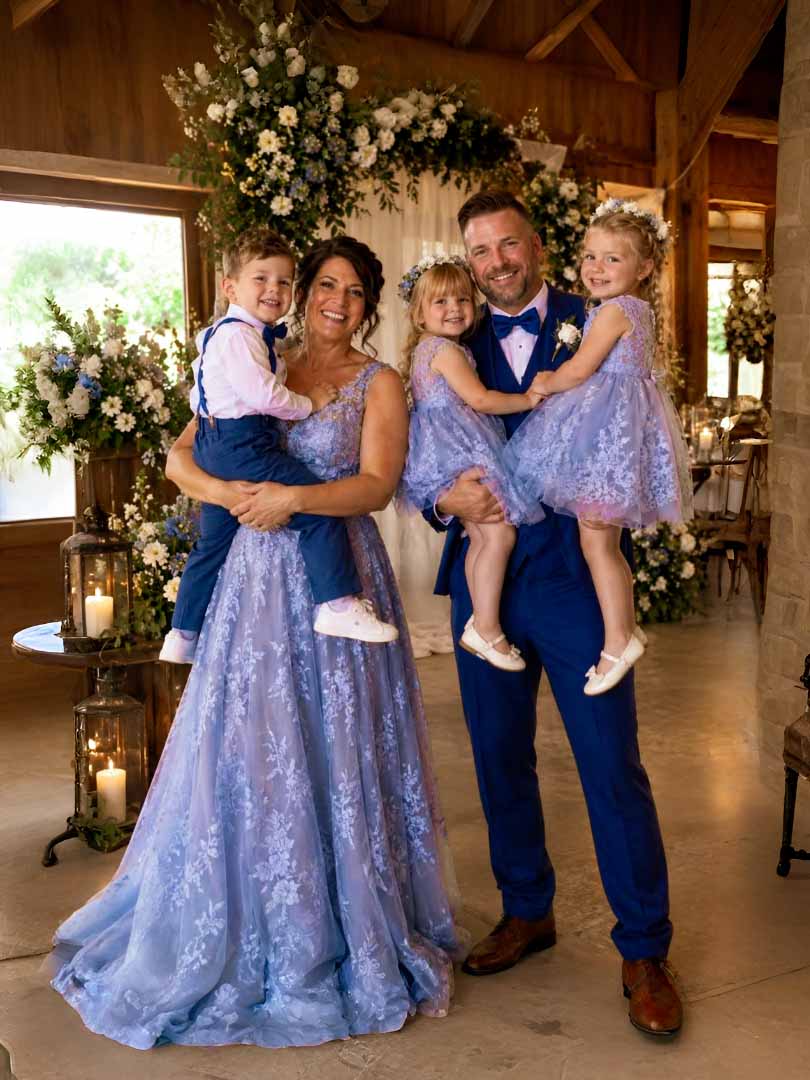
A year after the canceled wedding, Monica—the wedding planner—sent me a photograph.
I had forgotten she took it.
It showed me standing at the reception with Harry and the twins.
I was still in my wedding dress.
Harry’s tie was crooked.
Grace had cake frosting on her cheek.
Lily was laughing.
And all four of us were holding each other.
Oliver wasn’t in the photograph.
Neither was Sarah.
I stared at it for a long time.
Then I framed it.
It sits in our living room now.
People sometimes assume it is a wedding photograph.
Technically, I suppose it is.
Just not the kind they expect.
Because that day still marked a commitment.
Only not to Oliver.
It was the day I recommitted myself to the family I already had.
Harry is seventeen now.
He recently started teaching Lily how to drive in an empty school parking lot.
This terrifies me.
Grace joined the debate team.
Lily decided she wants to become a veterinarian, although last month she wanted to design video games, so we’ll see.
And me?
I’m still forty-something.
Still working.
Still paying bills.
Still forgetting laundry in the washing machine occasionally.
Still tired more often than I’d like.
But I no longer confuse having a partner with having security.
Those are not the same thing.
A partner can add to your life.
A good one should.
But security built entirely around another person can disappear the moment that person changes.
The house is still mine.
My savings are still mine.
The twins’ money remains protected.
Harry has started applying to colleges.
And the documents Oliver wanted me to sign?
I kept them.
Not because they have any legal importance now.
They don’t.
I keep them in the same folder as a printed transcript of the accidental FaceTime call.
On the front of that folder, I wrote one sentence:
LISTEN WHEN PEOPLE TELL YOU WHO THEY ARE.
Sometimes the truth arrives through an investigation.
Sometimes through a confession.
Sometimes through a friend.
And sometimes—
someone simply forgets to disconnect a call.
Two years after the canceled wedding, I ran into Oliver.
It happened in a grocery store.
Nothing cinematic.
No rain.
No dramatic music.
I was standing in the produce section comparing avocados.
Someone said:
“Sharon?”
I turned.
There he was.
He looked older.
Not dramatically.
Just enough.
We stared at each other.
Then he smiled awkwardly.
“Hi.”
“Hi.”
For several seconds, neither of us knew what to say.
Finally, he asked:
“How are the kids?”
“They’re good.”
“Harry?”
“Applying to universities.”
“The twins?”
“Growing too quickly.”
He smiled.
“I miss them.”
I didn’t answer.
He looked down.
“I know I don’t have the right to say that.”
“No.”
“I do, though.”
“I believe you.”
He looked surprised.
And I meant it.
People can exploit someone and still develop genuine feelings.
Human beings are messy.
That didn’t erase what he had done.
Oliver looked at the avocados in my hand.
Then he laughed softly.
“Still squeezing every one?”
“You taught me that.”
His smile disappeared.
We both remembered too much.
Finally, he said:
“I was desperate, Sharon.”
“I know.”
“I convinced myself I’d fix everything after we got married.”
I looked at him.
“How?”
He swallowed.
“I don’t know.”
That was probably the most truthful thing he had ever said about his plan.
“I did love you.”
I nodded.
“I think you probably did.”
His eyes filled.
“But?”
“But love doesn’t make deception harmless.”
He looked away.
“I ruined everything.”
“Yes.”
I didn’t say it cruelly.
Just accurately.
After a moment, he asked:
“Do you hate me?”
I thought about it.
“No.”
That surprised him.
“I hated you for a while.”
“And now?”
“Now I mostly don’t think about you.”
That hurt him.
I could see it.
But it wasn’t meant as punishment.
It was simply true.
Oliver had once occupied enormous space in my life.
Then, slowly, he became a memory.
He nodded.
“I’m glad you’re okay.”
“I am.”
I placed two avocados in my cart.
Then I started walking away.
“Sharon?”
I turned.
He looked at me.
“I’m sorry.”
For once, there was no excuse afterward.
No explanation.
No request.
Just those two words.
I nodded.
“I know.”
Then I walked away.
That night, I found Harry in the kitchen making sandwiches.
“You bought avocados?”
“Yes.”
“Finally.”
“Don’t get excited. They’re for tomorrow.”
He rolled his eyes.
I watched him for a moment.
Then he noticed.
“What?”
“Nothing.”
“You’re being weird.”
“I ran into Oliver today.”
His hands stopped.
“Where?”
“The grocery store.”
“Did he bother you?”
I smiled.
That immediate protectiveness.
“No.”
“What did he want?”
“Nothing.”
Harry studied me.
“You okay?”
“Yes.”
And I realized I truly was.
Then he asked:
“Do you ever wish you hadn’t heard the call?”
The question surprised me.
I thought about the wedding that never happened.
The humiliation.
The grief.
The nights the twins cried.
The months it took to trust my own judgment again.
Then I imagined the alternative.
Marrying Oliver.
Signing documents.
Combining accounts.
Maybe discovering the truth only after money disappeared.
Maybe after he left.
Maybe after the children became even more attached to him.
“No,” I said.
“Not for one second.”
Harry nodded.
Then went back to his sandwich.
A few minutes later, Grace came downstairs looking for a charger.
Lily followed because apparently nobody in our house can look for anything alone.
Within five minutes, all four of us were crowded into the kitchen.
Someone opened ice cream.
Harry complained that Lily had stolen his charger.
Grace accused Harry of eating something she’d labeled.
I stood there listening to them argue.
And I smiled.
Oliver had believed he was offering me the one thing I needed most.
A family.
That was his biggest mistake.
I already had one.
A loud one.
A complicated one.
A family born from loss, responsibility, love, and a thousand ordinary days when we chose to keep showing up for one another.
Oliver didn’t create that.
And when he left, he couldn’t take it away.
The night before my wedding, I thought an accidentally connected phone call had destroyed my future.
It hadn’t.
It had exposed a future that was never real.
There’s a difference.
The next morning, when I walked down that aisle, Oliver believed I was walking toward him.
I wasn’t.
I was walking toward the truth.
And when I stopped the ceremony, protected my home, protected my savings, and chose my children over the man who had used their trust as part of a financial plan—
I didn’t lose a husband.
I avoided marrying a stranger.
People still occasionally ask whether canceling the wedding in front of everyone was too dramatic.
Maybe.
I could have canceled quietly.
I could have sent messages before the guests arrived.
I could have saved Oliver the humiliation.
But then I remember Sarah’s laugh.
I remember Oliver calmly explaining that after everything became shared, he wouldn’t have to stay.
I remember the documents he expected me to sign.
And most of all, I remember my son standing in that aisle and saying:
“She isn’t alone. She has us.”
He was right.
I had spent years believing strength meant carrying everything myself.
It doesn’t.
Strength is also knowing what deserves protecting.
My children.
My home.
My future.
And myself.
Oliver forgot to disconnect one call.
That mistake cost him the wedding he had planned.
But it saved me from the marriage he had planned afterward.
And if there’s one thing I learned from the day I almost married him, it’s this:
Never marry someone simply because they make you feel less alone.
Marry the person who makes you feel safe enough to remain fully yourself.
Oliver wanted access to everything I had built.
Instead—
he walked out of our wedding with exactly what he had brought into my life.
Nothing that belonged to me.
—-THE END—-